
Lithium ion battery
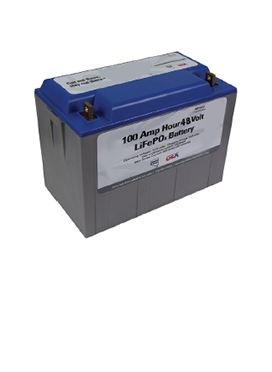
A lithium-ion battery or Li-ion battery is a type of rechargeable battery in which lithium ions move from the negative electrodde to the positive electrode during discharge and back when charging.It can use an intercalated lithium compound as one electrode material, compared to the metalic lithium used in a non rechargeable lithium battery The electrolyte, which allows for ionic movement
CHARACTERISTICS OF LITHIUM-ION BATTERY USING VARIOUS CHEMISTRIES
| Chemistry Anode/cathode | Cell voltage Max/nom | Ah/gm Anode/cathode | Energy density Wh/kg | Cycle life (deep) | Thermal stability |
| Graphite/ NiCoMnO2 | 4.2/3.6 | 0.36/.18 | 100-170 | 2000-3000 | fairly stable |
| Graphite/ Mn spinel | 4.0/3.6 | 0.36/.11 | 100-120 | 1000 | fairly stable |
| Graphite/ NiCoAlO2 | 4.2/3.6 | 0.36/.18 | 100-150 | 2000-3000 | least stable |
| Graphite/ iron phosphate | 3.65/ 3.25 | 0.36/.16 | 90-115 | >3000 | stable |
| Lithium titanate/ Mn spinel | 2.8/2.4 | 0.18/.11 | 60-75 | >5000 | most stable |
TEMPERATURE
LI-ion batteries offer good charging performnce at cooler temperature and may even allow fast charging with in a temperature range of 5-45°c (41-113 F)
PERFORMANCE
Specific energy density : 100 to 250 W.h/kg (360 to 900 kJ/kg)
Volumetric energy density : 250 to 620 W·h/L(900 to 2230 J/cm³)
Specific power density : 300 to 1500 W/kg (at 20 seconds and 285 W·h/L)
USES
Li-ion batteries provide lightweight, high energy density power sources for a variety of devices
Portable devices : these include smrt phones,laptops,digital cameras,caamcorders ,electronics cigrets etc
Power tools : Li-ion batteries are used in tools such as cordless drills,sanders,saw etc
Electric Vehicles : including Electric cars hybrid vehicles, electric bicycles,personal transportes etc
SAFETY
If overheated or overcharged, Li-ion batteries may suffer thermal runaway .and cell rupture. In extreme cases this can lead to leakage, explosion or fire. To reduce these risks, many lithium-ion cells (and battery packs) contain fail-safe circuitry that disconnects the battery when its voltage is outside the safe range of 3–4.2 V per cell
ISO 9001:2015 JAS- ANZ

Power Systems
Tele Communication Systems
IEC Standard 61300-3-3--5
Quality Management
Quality Control